
Lavender vs Lavandin: A Complete Comparison
Lavender and Lavandin are the most popular aromatic plants for gardens and commercial use. However, many people confuse them, thinking they are the same plant. In this article, I’ll explain their similarities and differences so you can easily tell them apart.
Before proceeding, and to prevent any potential confusion, let’s establish clear definitions for Lavender and Lavandin in this article.

STRUGGLING TO FIND THE RIGHT PLANTS FOR YOUR GARDEN?
With PLANT ID CARDS, you can find the perfect plants in minutes.

Lavender (Lavandula angustifolia)
There are many different species of lavender, but in this article, we refer to the English lavender (Lavandula angustifolia), also known as common lavender, which is the one often confused with lavandin.
Lavandin (Lavandula x Intermedia)
Lavandin is a hybrid lavender. However, there are many hybrid lavenders that result from a cross between lavender parents like for example Lavandula x allardii (L.latifolia and L.dentata), Lavandula x ginginsii (L.dentata x L. lanata), Lavandula x cavanillesii (L. angustifolia × L. dentata) and many more.
In this article, I refer to the hybrid Lavandula x intermedia (L. angustifolia x L. latifolia), also called Lavandin.
Let’s compare these two plants based on their visual characteristics, ecological characteristics, origins, and uses.
Lavender vs Lavandin – Visual comparison
While Lavender and Lavandin have similarities in their flower, stem, leaf and growth habits, there are also some notable differences. Let’s check them out:
Flower

| Lavender | Lavandin |
| Inflorescence is smaller and more compact. Flowers are typically a dark blue-purple or pinkish, with blue-mauve buds. Flowering earlier – mid June to early July. | Inflorescence is longer and more spike-shaped. Flowers are typically light purple to white, with greyish purple buds. Flowering later mid July – late July |
Leaf

| Lavender | Lavandin |
| Narrower leaf (linear lanceolate). Grey-green covered in fine hair. | Broader leaf (Linear lanceolate to spathulate). Grey-green covered with fine hair. |
Stem

| Lavender | Lavandin |
| Thin and unbranched. Shorter and more densely packed with leaves. | Thicker and branched with lateral shoots also carrying flower heads. Longer and more loosely packed with leaves. |
Plant
| Lavender | Lavandin |
| A mounding cushion form growing lower to the ground with shorter and more compact stems. Average size: height: 30 cm (1 ft) and flower stalk 60 cm (2 ft). Width 30 to 60 cm (1 to 2 ft). | An upright to mounding cushion form. Growing higher with taller and less compact stems. An overall larger size. Average size: height: 40cm (1.3 ft) and flower stalk 70 cm (2.6 ft). Width 60 to 90 cm (2 to 3 ft). |
Lavender vs Lavandin – Ecological comparison
Although both these plants are hardy and drought-tolerant, they have some differences. Lavender is a bit more resistant to cold and frost while Lavandin is a bit more resistant to drought.

Lavender vs Lavandin – Origin comparison
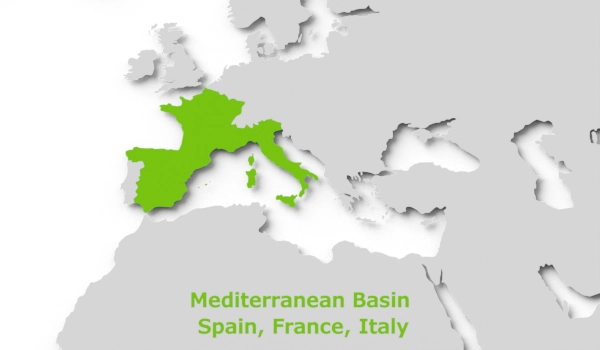
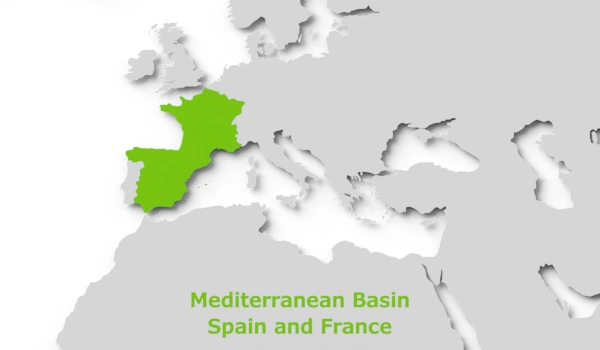
Both Lavender and Lavender originate from the Mediterranean basin. While Lavender is a little more widely spread (Spain, France, and Italy), Lavandin appears naturally in a more restricted area (Spain and France).
Lavender can be found growing at higher altitudes while Lavandin can only be found at lower altitudes because Spike Lavender, the other one of its parents, grows at lower altitudes.
Lavender origin
Lavandin Origin
Lavender vs Lavandin – Usage comparison
In addition to their ornamental value in gardens, both Lavender and Lavandin have many other uses. Let’s compare them.
| Lavender | Lavandin | |
|---|---|---|
| Oil Production | Lower yeild | Higher yeild (3 times more per kg) |
| Production Costs | More expensive to produce | Cheaper to produce |
| Fragrance | Milder and more sweet floral fragrance | Stronger and more pungent fragrance (higher camphor percentage) |
| Aromatherapy | For a sedative effect | For stimulating effect |
| Commercial Use | Perfumery, soap, and body care products. | Household soaps, cleaning products, and air fresheners. |
| Culinary | Widely used due to its mild and sweat flavour | Not very appreciated due to its strong camphor scent. |
| Medicinal | Sedative, antidepressant, antiseptic, antifungal (source) | Antioxidant, antimicrobial, insecticidal, anti-inflammatory, analgesic. (source). |
If you are interested in Lavender, grab your complimentary guide below. It’s nicely packed into a PDF format for easy offline downloading and reading.

Get your FREE ebook!
A complete guide to 7 Lovely Lavender varieties!


