
Cupressus sempervirens (Italian Cypress)
Cupressus sempervirens, commonly known as Mediterranean Cypress or Italian Cypress, is a large evergreen conifer tree with dense, dark green foliage composed of small, upward-pointing, scale-like leaves.
This tree can have two distinct forms: a narrow columnar with upright branches or a broader triangular with horizontal branches.
The columnar variety, known as Cupressus sempervirens ‘Stricta’, is the most popular for gardens. This elegant living sculpture creates a striking vertical accent, iconic in Mediterranean landscapes, particularly in Italy, which is why it’s commonly known as the “Italian cypress.”
It is a hardy, drought-tolerant ornamental tree native to the region stretching from the Eastern Mediterranean to Iran. However, its beauty and high-quality wood led to its spread to nearby countries since ancient times, and today it is widely cultivated around the world.

Quick Overview
TYPE

HEIGHT & WIDTH

BLOOM TIME
SUNLIGHT

HARDINESS

DROUGHT TOLERANCE

ORIGIN

Italian Cypress Botanical name
- Botanical name: Cupressus sempervirens (ku-PRES-us sem-per-VY-renz)
- Family: Cupressaceae (koo-preh-SAY-see-ee)
- Common name: Italian Cypress, Mediterranean Cypress, Common Cypress
| Name | Meaning |
|---|---|
| Cupressus | Derived from the Greek word “kuparissos” referring to cyprus trees. It may also be associated with the myth of Kyparissos, a young man transformed into a cypress tree by Apollo. |
| sempervirens | The Latin word meaning “always green” referring to its evergreen nature. |
How to identify Cupressus sempervirens
Plant
Cupressus sempervirens is a tall evergreen conifer with green foliage that keeps its vibrant colour all year round. It has a straight greyish-brown trunk with thin bark composed of shallow vertical fissures. It starts branching from the base of the trunk.
This cypress tree has two main forms:
The columnar form (“stricta”) often has multiple trunks, with upright branches that closely hug the trunk, creating a dense crown that tapers at the top. Only the base of the trunk is visible. This is the most popular form for ornamental landscape designs.
The cone form (“horizontalis”) has a single trunk and spreading horizontal branches. The crown tapers at the top, creating an overall conical shape. This is considered the original form and is mostly used for silvicultural purposes.
Cupressus sempervirens has a deep tap root system. This allows it to anchor firmly into the soil, enabling it to draw water and nutrients from deep underground and help the tree withstand strong winds.
It is a slow-growing tree and can live for hundreds of years.
The columnar form of this cypress is, on average, 12 to 20 m (40 to 70ft) high or more and 1 to 2 m (3 to 6 ft) wide.

Stem
The stems of Cupressus sempervirens start branching from the bottom of the trunk(s) are grey-brown, cylindrical, and slightly grooved.
They are upright and pressed close to the trunk. They progressively subdivide into alternate shoots that radiate in all directions, creating three-dimensional sprays.
The branching pattern is slightly more spread out on the outside of the tree´s surface and more flattened towards the interior, where the branches are pressed against the trunk.
The twigs are covered by tiny, flat, scale-like leaves. These leaves are arranged in opposite pairs, alternating and overlapping along the length of the twig, creating a quadrangular or cylindrical “needle”.
The twigs, in turn, radiate in all directions, creating three-dimensional, fan-like sprays that give the tree its distinctive texture and appearance.

Leaf
The green, scale-like leaves have a waxy coat and a small groove, or furrow, on their outer surface. They are oval-shaped with rounded tips.
The size is around 1 mm, so small that individual leaves are difficult to see. What stands out is the overall pattern they form:
The leaves are tightly arranged in alternating opposite pairs and pressed closely against the twigs, resulting in a “needle” with a quadrangular form. These green needles are easily visible.

Flower
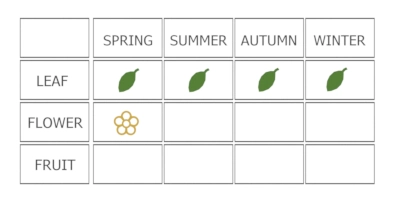
The flowers of Cupressus sempervirens are small cones. Unlike typical flowers, they do not have a calyx, corolla, stamens, or pistils. Instead, they have a central axis with scales and bracts.
The male and female cones are separate but exist on the same tree.
Male Cones
The male cones are small and cylindrical, measuring about 3-5mm long and 2mm wide.
When mature, they turn yellow and can be easily seen at the tips of branches, usually on the lower part of the tree´s crown.
From mid-winter to early spring, these male cones are covered in pale salmon-coloured pollen, which the wind disperses to fertilize female cones on the same or nearby trees.
Female cones
The female cones are ball-shaped (globose) and larger. They are about 2-4 cm long and 2-2.5 cm wide and located in the upper part of the crown. They have 8-14 opposite scales that are glossy, wrinkled, and have a blunt point at the centre.
Before fertilization, they are tiny with open scales. Then, the scales close up to protect the seeds and gradually become larger, glossy, and brownish-green.
As the seeds mature over several months, the cone gradually turns brown and becomes more woody. It can remain in this state for many years until conditions are favourable for the seeds to germinate, like strong heat from a wildfire.
Seeds
The seeds mature after one year between summer and late autumn. At this point, the scales open slightly. In autumn or winter, the scales open more, and the seeds are finally released.
Each scale contains about 8-15 seeds, each averaging 4-5mm long and 3-4mm wide.
The seeds are reddish, flattened, and have narrow wings that allow them to be carried by the wind to germinate in new locations.
After releasing the seeds, the cone can remain on the tree for several years.
Interested in low-maintenance plants? I have a special offer for you. Click the button below to download four free guides.
I am pleased to offer you my collection of free drought-tolerant plant guides.

A hand-picked selection of drought-tolerant plants bundled into a collection of exclusive FREE ebooks just for you!
Cupressus sempervirens Habitat
Cupressus sempervirens is native to regions with a Mediterranean climate, making it well adapted to hot, dry summers and winter rains.
It thrives in full sun in rocky areas, open woodlands, valleys, and coastal mountains. This tree can grow in a variety of soils, as long as they are well-drained and at altitudes ranging from sea level to over 2000 meters (6,500 feet).
Cupressus sempervirens Usage
Ornamental
The Italian Cypress is prized for its elegant columnar shape and evergreen foliage that remains vibrant all year round. It provides a constant structure to the garden and adds a striking vertical accent to landscapes, evoking a distinct Mediterranean atmosphere.
Its visual appeal and robustness make it a popular choice for low-maintenance gardens in sunny locations.
It can be used in the landscape in the following ways:
- Focal point: Its tall, slender, and columnar form creates an exclamation mark that naturally draws the eye to it and upward into the sky. Its vertical silhouette contrasts with the more rounded or spreading shapes of other plants.
- Avenue or Pathway Lining: Italian Cypress creates a grand, formal look when planted along driveways or walkways.
- Framing Entrances: Planted in pairs or clusters to frame doorways, gates, or garden entrances.
- Living walls and windbreaks: When planted close together, its dense evergreen foliage and narrow form create a solid living barrier. This provides privacy, reduces wind flow, and blocks noise. Its narrow width makes it ideal for both small and large gardens.
- Minimalist and formal gardens: Its clean, architectural form creates a vertical living sculpture that adds interest without overwhelming the space. Its sleek silhouette contributes to a calm, uncluttered look, perfectly aligning with minimalist and formal design principles.
- Mediterranean gardens: Its drought tolerance and resilience to hot, dry summers make it well-suited for sun-exposed areas of Mediterranean-style gardens. It adds a touch of timeless elegance and authentically evokes a Mediterranean atmosphere.
- Container gardens: Due to its narrow form it can be used in containers for small areas such as patios, terraces, or balconies adding height and elegance to these areas.
- Seaside gardens: Salt tolerance and wind resistance make it ideal for coastal gardens.
Italian Cypress can be combined with the following plants:
It can be used as a standalone specimen or in a group of two or three surrounded by grey foliage of other drought-tolerant plants such as Artemisias, lavenders, and Russian sage, creating a contrast of colour and form while maintaining the unity of fine texture.
It also combines well with sabine and creeping junipers, creating an interesting contrast in form while maintaining the unity of texture.
It also pairs well with drought-tolerant grasses, creating a striking contrast between the rigid form of the Mediterranean cypress and the airy and dynamic appearance of the grasses.
Carpentry
The wood of Italian cypress is very hard and durable, which makes it suitable for small carpentry.
Its resilience to weathering is particularly valuable for outdoor woodworks such as doors, windows, garden furniture, and even ships.
Its wood keeps its fragrance after being cut. This odour repels moths and woodworms, making it particularly useful for chests and wardrobes, where clothing and food are stored.
Reforestation
The Italian cypress can grow in poor soils and withstand harsh climatic conditions, including extreme heat, drought, and some degree of cold.
These characteristics have made it an ideal choice for reforestation projects in areas where other plants struggle to survive.
Fire Barrier
Due to its ecological qualities, such as its high water content, a crown that is difficult to ignite and dense litter, the Mediterranean cypress is used as a natural firebreak to help control wildfires in sensitive areas like wildland-urban interfaces.
Learn more about the usage of this cypress as a fire barrier in this article: https://www.bbc.com/news/science-environment-34116491
How to care for Cupressus sempervirens
Cold exposure
This cypress can tolerate some frost and cold weather down to -15ºC (5º F) or more. But only if the soil is well drained. Cold, soggy soil can be fatal to it.
Young plants are more tender and may not resist extremely cold temperatures, so you will need to protect them for the first two winters until they are more established and stronger.
Wrap them with a white fleece during the coldest time of the winter and add a thick layer of mulch around the plant’s base to protect the roots from cold temperatures. Using gravel mulch is preferable because organic mulch will stay humid and can cause the plant to rot.
Sun exposure
Mediterranean Cypress needs full sun to thrive.
In extremely hot climates or areas with intense sunlight, and especially before the young tree is established, it should be protected from the harsh afternoon sun. Shield the plant from excessive heat and strong sunlight during the first 2 or 3 years. Once established, it will handle the harsh weather conditions.
Soil
Italian Cyress thrives in poor, well-drained soils, particularly those with a gritty, rocky texture. It’s best to avoid planting it in damp locations, as it is not tolerant of soggy soil, which can increase the risk of root rot.
It can tolerant all types of soil PH from mildly acidic to mildly alkaline soils.
Don´t fertilize the soil if you want the plant to stay robust and better equipped to handle extreme temperatures. In richer soils, the plant tends to grow floppy and weak, with branches spreading out and disrupting the neat, compact structure that gives the tree its elegant appearance.
Watering
The Italian cypress is very drought tolerant and can go for months without water once it is established (about 6 months of drought if the temperature is not too hot).
Once established, it does not need watering, especially if you want to maintain its neat, compact structure. However, if there’s a long period without rain, especially if the winter was dry, you may give it a drink if you see it needs it.
During the first two or three years after planting, it’s essential to water the young plant regularly. Depending on the soil and the temperatures, you may need to water it once a week or every two or three weeks.
When you water the tree, make sure to give it plenty of water, allowing the soil to soak well. This way, the water can sink deep into the soil, keeping it moist for longer.
Mulch should be added around the plant’s root area to preserve the soil’s moisture.
Wind Exposure
Although the Italian cypress can tolerate wind, including sea wind, it is not very resistant to cold, drying winds. If your area experiences such winds, you may need to plant it in a more sheltered location.
Pruning
This tree should never be hard pruned because it can cause the spread of diseases and will leave “holes” in the crown.
To keep the Italian cypress compact and neat, give it light trim (without cutting into the older wood) once or twice a year from late spring to late summer. This encourages denser branching and prevents the tree from developing those floppy branches.
Another way to keep it neat without flopping branches is to secure it with a fishing line while it is young and growing rapidly. This will help keep the branches in place until they are strong enough to support themselves.
This video can help you understand how to keep the Italian cypress looking neat.

When to plant Cupressus sempervirens
The best season to plant the Italian cypress is during its winter dormancy period, which is from late autumn to early Spring.
How to propagate Cupressus sempervirens
Cupressus sempervirens can be propagated by seed or by cuttings.
Seed: Later winter to early spring
Since these trees are native to the Mediterranean region, where wildfires are common, they have adapted to reproduce in such conditions. Their seed cones only open after being exposed to intense heat, allowing the tree to quickly reforest areas devastated by fire. So the first step requires you to mimic those conditions.
- Place the cone on a hot place until it opens (oven or radiator)
- Sow the seeds in a well-draining medium. Lightly press the seeds into the soil, just covering them with a thin layer, as the seeds need light to germinate.
- Maintain consistent moisture but not soggy (cover with a plastic lid or bag) and provide indirect light.
- For best germination, maintain a temperature between 10 – 20ºC (50 – 70ºF). The seeds should germinate in five to six weeks or sometimes several months.
- Water from the base of the container (don´t water overhead)
- Once the seedlings have grown a few sets of true leaves, transplant them into individual containers and grow in cold frame during the first winter.
- Harden them to outdoor conditions and then plant into their permanent positions after the last expected frosts.
Stem cuttings: semi-hardwood cuttings in late summer or early autumn.
- Cut the stem just below a leaf node or rip off from the mother branch to take a heel cutting.
- Remove the lower twigs, leaving a few pairs of upper ones intact.
- Plant in a well-draining medium. Keep the medium consistently moist and keep in the shade until rooted.
- Once the roots have developed, transplant the rooted cuttings into individual containers and grow in cold frame during the first winter, exposing them to as much sun as possible.
As not all cuttings will root, take several to increase your chances of success.
Sources for this article
Article from Kew
Article from Monaco Nature Encyclopedia
Article from the official site of the European Union
Article from Botany Brisbane